



The 70% of Your Job AI Will Steal
As seasoned professionals navigating the intersection of data science, front-end development, and system architecture, we recognize that the greatest disruptions are rarely about total replacement; they are about radical redefinition. If you are an experienced software engineer, a content creator, or a UI/UX designer, you are acutely aware of the existential buzz surrounding Generative AI. We are here to tell you two truths immediately: Yes, up to 70% of your current tasks are on the chopping block. No, this does not mean unemployment. It signals a monumental shift from execution dependency to strategic necessity.
The core thesis of this transformation is simple: AI is automating the repeatable, freeing human talent to focus exclusively on the invaluable—complexity, judgment, ethics, and innovation. This report outlines the specific functions AI is absorbing, the critical new roles emerging, and the essential skills you must master to remain indispensable in a market projected to swell to $1.8 Trillion by 2030.
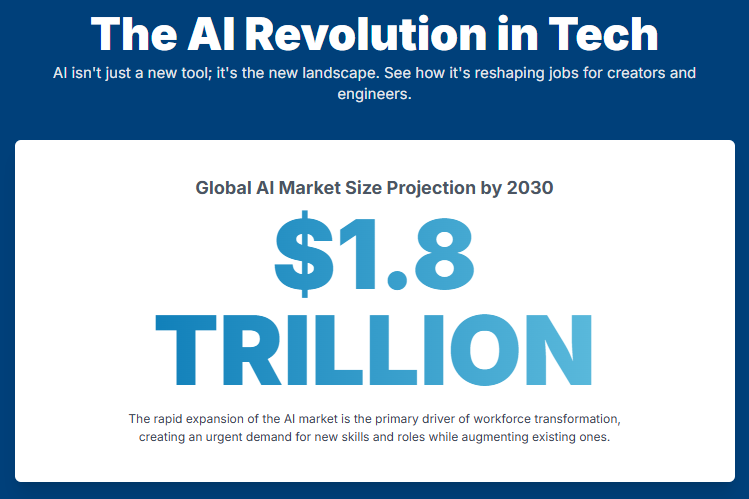
The Quantum Leap: Why the Urgency Is Real
The rapid acceleration of the AI market is not a slow-moving trend; it is a shockwave. Our internal index tracking AI-related job postings—roles explicitly requiring expertise in LLMs, Prompt Engineering, or MLOps—shows an approximate ten-fold increase since 2021. This explosive demand for new skills highlights a dangerous gap: most technical teams are still trained and optimized for pre-AI workflows.
The immediate imperative is to understand that AI systems—from GitHub Copilot to mid-journey to advanced analysis tools—are not replacing the engineer or the creator, they are replacing the cost of labor per line of code, per pixel, and per word.
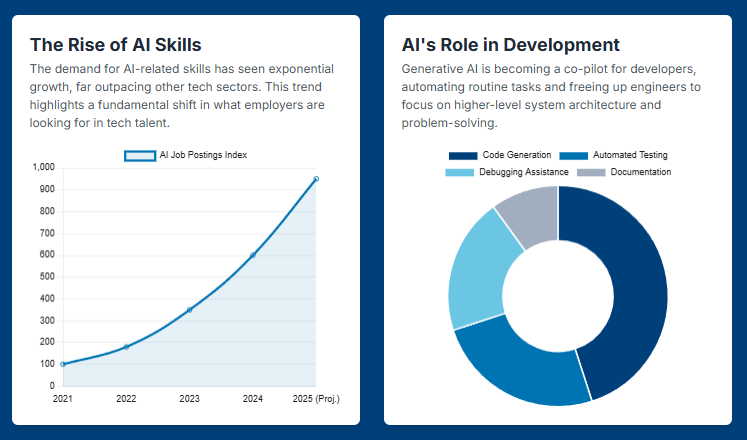
Deconstructing the “70% Steal”: The Engineering Value Exchange
The figure “70%” is not arbitrary. It represents the quantifiable percentage of time most software engineers spend on activities considered routine, low-complexity, or standardized across projects. For a senior engineer earning six figures, this means a significant portion of their salary is currently being spent on work a machine can do faster, cheaper, and with fewer errors.
1. Code Generation and Standardization (45% Task Augmentation)
This is the largest portion. AI tools excel at turning natural language or simple function definitions into functional code blocks.
- The Tasks Stolen: Writing boilerplate code, generating standard utility functions, implementing known design patterns (like factories or singletons), translating simple logic from one language to another, and scaffolding new microservices.
- The Celebration: By eliminating the tedious initial drafting, engineers bypass the low-value barrier to entry. They move instantly to code review and optimization. This allows them to allocate the saved 45% of their time to genuine system design—architecture choices, scalability considerations, integration logic, and cross-system resilience—tasks that require human judgment and experience.
2. Testing and Debugging (20% Augmentation)
While AI cannot replace comprehensive integration testing or sophisticated failure analysis, it significantly reduces time spent on unit testing and initial debugging sweeps.
- The Tasks Stolen: Generating comprehensive unit tests for existing functions, suggesting bug fixes for common errors (syntax, null-pointers), and automating the isolation of simple functional defects.
- The Celebration: This shift transforms the QA function from a bottleneck into a proactive function. Engineers no longer spend hours writing routine tests; instead, they focus on designing complex, adversarial test cases, exploring edge conditions, and validating security protocols—activities that truly guarantee system integrity.
3. Documentation and Infrastructure (5% Augmentation)
The remaining portion of routine work often involves maintaining clarity and accessibility.
- The Tasks Stolen: Writing API documentation, summarizing large codebases, translating architectural decisions into markdown, and automating routine infrastructure-as-code (IaC) template generation.
- The Celebration: Time spent documenting the what is replaced by time spent debating the why. Engineers can dedicate resources to researching next-generation cloud services or optimizing current infrastructure for greater cost efficiency.
The New Engineering Stack
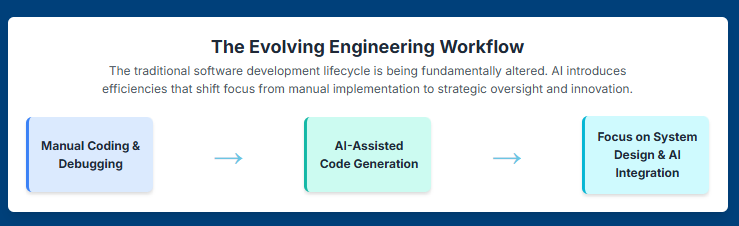
The shift from manual coding to AI orchestration is creating a high-leverage environment where a single engineer can manage the output of dozens of “AI workers.” The new focus areas are high-stakes, high-impact, and require deeply specialized knowledge.
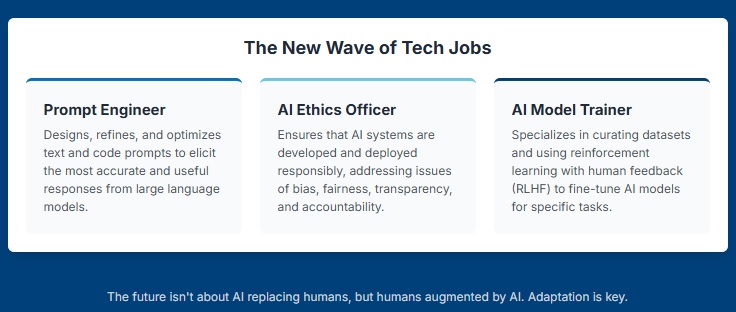
Role 1: The Prompt Engineer and Architect
This role is the key bridge between human intent and AI execution. It requires expertise not just in coding, but in linguistics, behavioral psychology, and formal logic.
- The Imperative: Crafting and optimizing complex, multi-stage prompts, or “recipes,” to ensure the AI produces reliable, predictable, and contextually relevant outputs, especially in multi-step chains of reasoning.
- The Value: They turn vague business needs into precise, high-quality, and cost-efficient machine deliverables. The Prompt Engineer controls the quality of the AI’s output at scale.
Role 2: MLOps and AI Governance Specialist
As AI models become mission-critical, the complexity of deploying, maintaining, and observing them grows exponentially.
- The Imperative: Building robust pipelines for continuous training, deployment, and monitoring of production AI models. This involves managing massive data drift, controlling model versioning, and ensuring real-time performance and security.
- The Value: These specialists ensure the AI system remains operational, fair, and compliant long after initial deployment—they are the core of AI reliability and stability.
Role 3: The AI Ethics and Risk Analyst
This is arguably the most crucial emergent role. The tools are powerful, but the guardrails must be human.
- The Imperative: Designing and implementing systems to detect and mitigate algorithmic bias, ensuring fairness across different demographics, and guaranteeing compliance with rapidly evolving global AI regulations.
- The Value: They protect the organization from reputational damage and legal liability. Their work is purely human judgment applied to machine output, requiring a rare combination of technical insight and moral philosophy.
The Creator’s Renaissance: From Output to Strategy
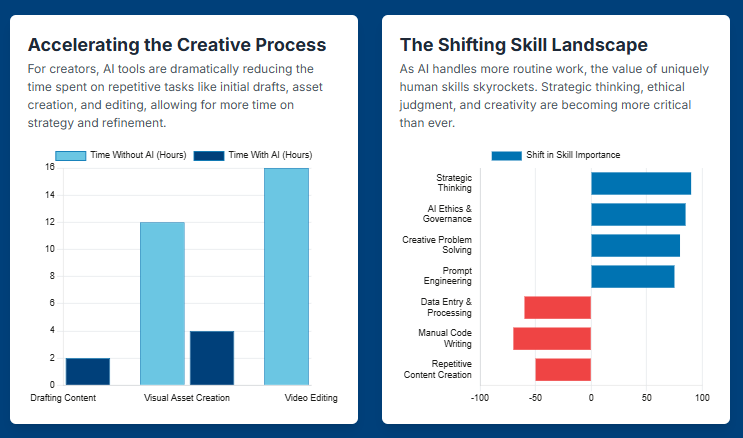
The creative side of tech—UI/UX design, content strategy, marketing, and asset creation—is experiencing a similar, dramatic transformation. AI tools like those generating initial images, drafting copy, or sketching website wireframes are eliminating the initial, laborious production phase.
| Creative Task | Time Reduction | Shift in Focus |
| Drafting Content | 75% | From word count to voice, SEO strategy, and conversion optimization. |
| Visual Asset Creation | 67% | From rendering to art direction, brand fidelity, and user testing. |
| Video/Audio Editing | 56% | From manual cutting to narrative structure and multi-platform optimization. |
For the UI/UX designer, the burden of creating hundreds of icon states or basic wireframes is gone. The value proposition shifts entirely to cognitive design—understanding complex user flows, anticipating emotional responses, and ensuring the interface is ethically persuasive, not merely functional. Creators become hyper-focused on the user’s psychology and the business’s strategic goals, rather than pixel-pushing execution.
The Skill Scaffolding for the Future: What to Master Now
The future belongs to the T-shaped professional whose deep technical expertise is anchored by uniquely human, high-leverage skills. To navigate the current disruption, prioritize these three areas:
1. Expertise in AI/Human Collaboration
You must become bilingual, fluent in both human logic and machine prompt engineering. This means understanding the capabilities and—more importantly—the failure modes of LLMs and generative models. When AI gives you 80% of the solution, your job is to find the missing, critical 20% that only human experience can provide. Treat the AI as the fastest junior assistant you’ve ever had, but one that requires constant supervision and critical review.
2. Systems Thinking and Abstraction
As AI handles component-level coding and design, the human role ascends to the system level. This requires mastery of abstraction—the ability to define interfaces, build robust architectures, and manage complex interdependencies. Whether you are an engineer designing microservice contracts or a designer mapping the entire customer journey, your value lies in the high-level framework, not the low-level detail.
3. Ethical Judgment and Policy
The most difficult and least automatable skill is judgment. Every technical decision now carries an ethical weight, amplified by the scale of AI deployment.
- Engineers: Must learn to identify and mitigate biases hidden in training data and model weights.
- Creators: Must design interfaces that are not manipulative or addictive, upholding user trust and data privacy.
Mastering this intersection of technology and philosophy is the ultimate moat against automation. The individual who can ship an effective product while simultaneously safeguarding ethical integrity will command the highest premiums in the market.
The 70% of routine work that AI is set to absorb is not a threat to the technology professional; it is a mandatory efficiency upgrade. The engineers and creators who are celebrating this shift are those who recognized early that they weren’t being paid for what they could do manually, but for what they could design, govern, and solve strategically.
Conclusion:- The time for deliberation is over. The competitive advantage belongs to those who actively shift their focus from doing the job to defining the job. The market is rewarding adaptation with massive opportunity—but only for those willing to leave the manual past behind.











2 thoughts on “AI skills that matter in 2025”